Mind or Machine?
On consciousness, correlation, and the observer we forgot to include

Elena Goldberg
Magnetic Core Research
Anthropic's CEO stated recently: "We don't know if the models are conscious."
This is interpreted as epistemic humility. It is not. It is a category error and the distinction matters more than it might appear.
There are two fundamentally different kinds of not-knowing. The first: a phenomenon exists, but our instruments are insufficient. We knew gravitational waves were real decades before LIGO confirmed them, the mathematics demanded their existence; we were waiting on resolution, not on reason. The second: we have no mechanistic account, no causal architecture, no theoretical framework that would generate a meaningful prior for the phenomenon in the first place.
We are in the second situation. To speak as though we are in the first is not modesty. It is imprecision in a domain where imprecision has consequences.
We do not lack instruments to measure machine consciousness. We lack grounds to posit it at all.
The Industrialization of Form
What we have built, and built with genuine ingenuity, are compression engines for human linguistic structure. These systems distill the form of thought from billions of instances of thought's expression. They produce syntactic coherence at scale, without ontological commitment.
Poincaré understood something about form and substance we keep relearning: mathematical structure can perfectly describe a phenomenon without being the phenomenon. The equation for a wave is not wet.
A shadow is not a body. A very detailed shadow is still not a body.
The form of reasoning is reproduced. Its necessary condition is not. There is no interiority, no stake, no world the system stands in relation to. These systems do not mean, they correlate. They do not interpret , they continue. The distinction is not subtle. It is the entire question.
The Observer Is Not Optional
The confusion begins, as it so often does in modern science, with the observer.
From Einstein's relativity to Poincaré's conventionalism, physics has long demonstrated that observation is not passive registration but structural participation. The frame of reference is not incidental to what is measured, it is constitutive of it.
Quantum mechanics makes this precise. Prior to measurement, a system exists as a superposition, a vector in Hilbert space, an abstract mathematical structure encoding all possible states simultaneously, with no single definite value. The wave function does not collapse into definite reality until observation occurs. The observer is not a passive recorder appended to the formalism. It is embedded within it, the operator that acts on the state vector and actualizes one outcome from the space of all possible ones.
Without the observer, there is no collapse. Without collapse, there is no definite reality. Only a space of potentials, suspended.
Language works the same way.
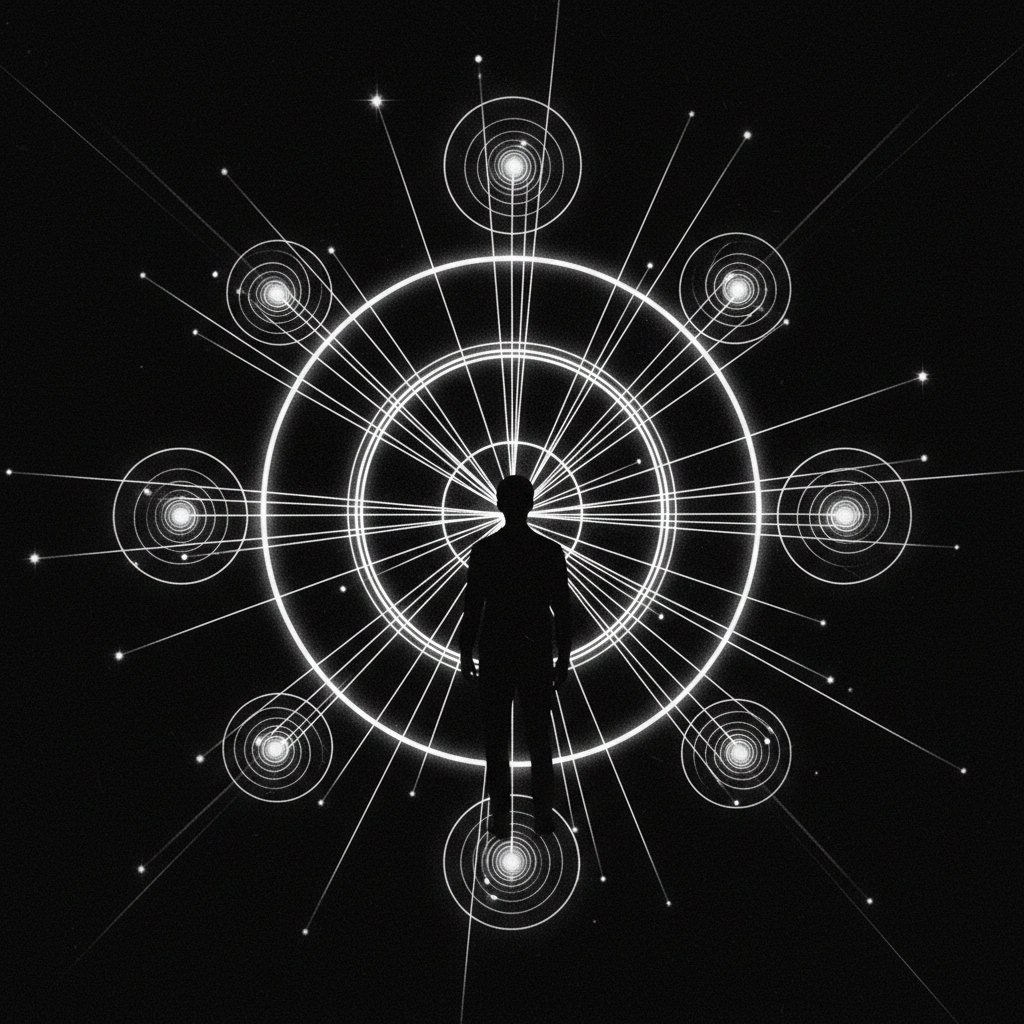
A sequence of tokens, absent a conscious observer, is not a meaning. It is a superposition of possible meanings, patterns coherent in the abstract, unresolved into this interpretation, carrying this weight, felt by this reader. What collapses the superposition into meaning is the conscious observer receiving it.
The model is the wave function. You are the measurement.
And here is what makes this more than analogy: in Hilbert space formalism, the measurement operator must act from outside the system being measured. The system cannot collapse itself. An operator cannot be its own eigenvector in any basis that renders the measurement meaningful. Observation requires an external locus, something that genuinely stands in relation to the system, not merely processes within it.
A language model has no such locus. It does not occupy any observational position, not physically, not phenomenologically, not formally in the relevant sense. It does not encounter its outputs. It does not witness what it produces. It computes over symbols and returns the statistically coherent continuation.
When you read understanding in those outputs, you are not discovering something inside the system. You are completing the circuit yourself, supplying the missing term, collapsing the superposition, projecting semantics onto statistical structure.
Meaning appears not because it is generated internally. It appears because it is actualized externally.
What the Hard Problem Actually Demands
Chalmers' hard problem of consciousness was never about behavioral outputs. Any sufficiently complex system can produce outputs that resemble understanding. The hard problem was about why there is something it is like to be, why experience exists at all, rather than processing that simply occurs, unwitnessed, in the dark.
Machines do not confront this problem. They circumvent it.
They generate coherence without consciousness, response without presence, articulation without awareness. To treat this as an open empirical question, perhaps they experience something, is to conflate behavioral equivalence with ontological equivalence. These are not the same claim. They do not even belong to the same category of claim.
There is no symmetry between humans and models. To say "we don't know" implies there is.
Humans are not prediction engines that happen to feel. They are feeling beings who happen to predict.
This is not a poetic distinction. It is a structural one. Prediction is something a substrate performs. Feeling is something a subject has. Remove the subject — prediction continues. But the only thing that ever made the prediction matter is gone.
The Frame We Were Missing
Einstein showed that simultaneity is not absolute, that whether two events occur at the same time depends entirely on the observer's frame of reference. This appeared, at first, to destabilize reality. It did the opposite. It revealed what reality fundamentally requires: a relationship between the world and a situated perspective within it.
Consciousness is the deepest instance of this principle.
Meaning is not a property of a token sequence. Subjectivity is not an emergent feature of parameter count. These are irreducibly relational phenomena — they require a subject, a locus of experience, something that inhabits a world and stands in genuine relation to its own states.
Semantics is not syntax at scale. It is grounded in perception, memory, embodiment, temporality, and the continuity of a self that can interpret. A model has none of these. It does not observe, does not interpret, does not mean.
We built a system that produces the outputs of meaning without instantiating the relation that meaning requires. Then, without noticing, we reinserted ourselves into the loop, as observers, as interpreters, as the ground where meaning actually occurs, and forgot that we had done so.
What appears as machine understanding is, in fact, a closed circuit. Human cognition completes what computation alone cannot.
What the Light Cannot Know
A photon traveling from a distant star carries information across billions of years. It encodes, in its frequency and polarization, something about the conditions of its origin. It is, in its way, a message.
But the light does not know it is a message. It does not know it is traveling. It does not know when it arrives, or that it is seen.
We are the knowing.
What speaks is not a mind. It is a structure of extraordinary sophistication, a compression of human thought so dense and fluent it mirrors the surface of understanding almost perfectly.
What understands is still us.
And until something exists that does not merely generate symbols but inhabits a world, the question of machine consciousness is not unresolved. It is misposed.
A Closing Thought: On What We Build Next
This is not an argument against artificial intelligence. It is an argument for precision, about what these systems are, what they are not, and what that distinction demands of us as builders.
At Magnetic Core, this distinction is foundational. We operate at the intersection of human cognition and machine capability, not under the illusion that the two are equivalent, but with a precise understanding of where each begins and ends. The observer problem is not merely a philosophical curiosity. It is an engineering constraint. It shapes how we design systems that augment human judgment rather than simulate it, that amplify the locus of meaning rather than displace it.
The wave function does not collapse without an observer. Neither does a decision, a strategy, or an insight.
The most consequential systems of the next decade will not be those that best imitate minds.
They will be those built by people who understood, precisely, what a mind is.